By Dr. Joel Rakow
How Gatekeepers Nearly Cancelled the Story I Want to Tell
Publishing literary fiction is challenging at any time, but I’ve encountered new roadblocks where they should never be. From editors twisting facts to my web hosting service throttling access to the book’s website for mysterious reasons. Now, I remain on high alert for the clash between power and voice.
What’s new: Layers of unofficial censors lying in wait at every publishing threshold. They silently dominate the industry, dodging accountability and due process while kidnapping the parts of American culture they don’t want you to see.
The Story and Inspiration
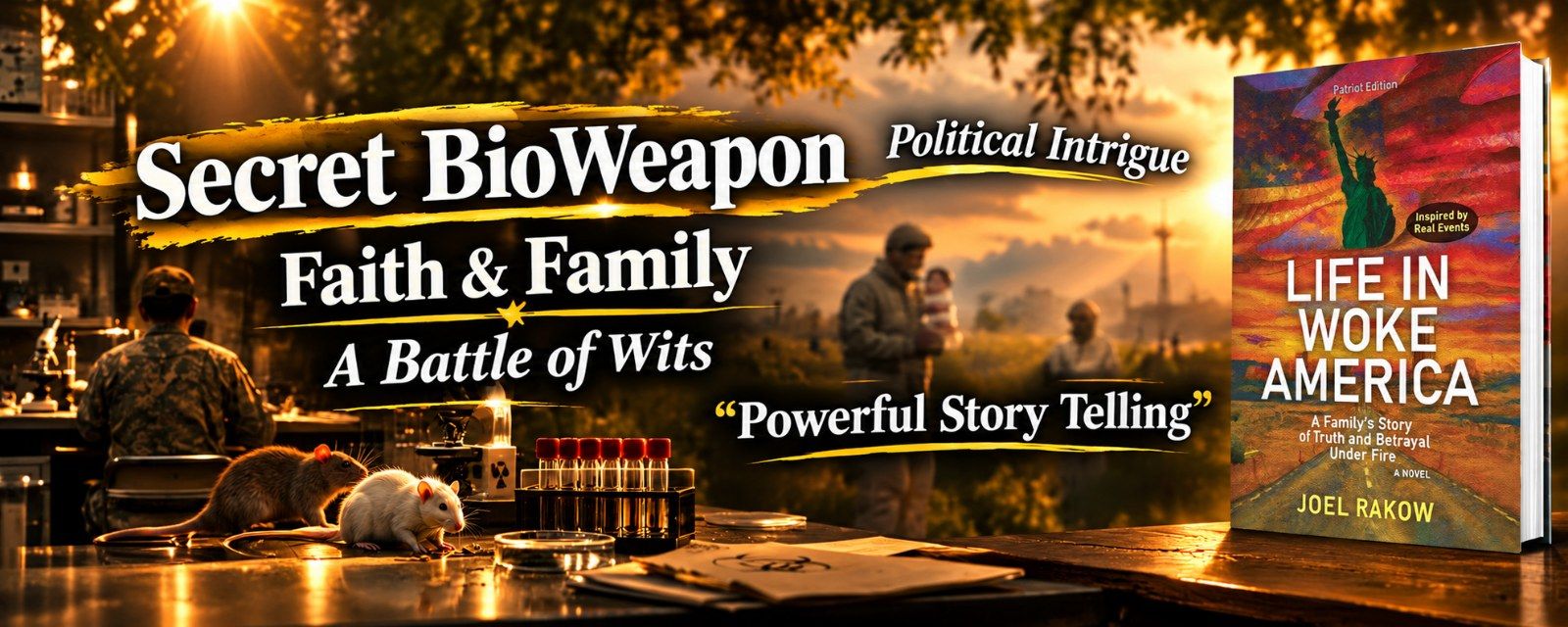
“Life in Woke America – A Hero’s Journey” tells a story that parallels the movie Saving Private Ryan while echoing George Orwell’s warnings. It’s a thoughtful tale about a lowly individual thrust into danger, overcoming institutional betrayal by pursuing the truth about self and society. Like Ryan, Xavier achieves worldly significance.
Xavier’s journey takes place in Texas, mostly the Panhandle. His challenges stem from a ‘color revolution,’ where sanctions masquerade as compassion.1 This upheaval is captured within the book’s title as “Woke America.” The story unfolds in cinematic detail and intimate dialogue, blending coming-of-age growth, international intrigue, hi-tech action, and a romance designed to flourish.
The plot draws from reality: the 2023 U.S. congressional probe into China’s bio lab near Fresno.2 The report details the secret bio lab’s operations by Chinese nationals who crossed the Canadian border during the previous administration.
It deserves a place on shelves and Kindles for its entertainment value, cultural insights, thriller sequences, and warning of overreach. Instead, it encounters quiet resistance that begins before any publisher inspects the manuscript, and it intensifies the instant the book’s website goes live.
The irony: This resistance mirrors the suppression Xavier faces. And I say this as a third-generation Democrat, from Nixon through Obama.
Early Gatekeeping: An Editor’s Withdrawal
One pre-publication experience stands out: A talented copy editor in Austin reads the first four chapters, praising them as “compellingly literary, with strong plotlines, and unique characters.” Excited, we sign his letter of agreement. He accepts payment and begins work. But later, he calls to back out, citing that it “rubs him the wrong way.”
He refunds the money, and we part amicably. Yet this real-life turn of events echoes my story’s portrayal of the dampening effects of an unspoken, unprofessional consensus that stands as an oppressive barrier that subverts contrary truths. He delays and denies progress on my work, even when literary quality and financial gain are not in question.
Silence from Mainstream Publishers
Submitting the manuscript to mainstream publishers is a silent affair. I query dozens, backed by beta readers who praise its “Orwellian fire with Atwood’s edge” and its potential as a “modern-day classic”. No responses come, as if the book’s portrayal of ‘wokeness in the wild’ holds no cultural or literary value. I take the silence as confirmation of the industry’s woke demand for compliance, shunning alternative views.
Hybrid Publishing: Promises and Pitfalls
Seeking to control what I can, I submit to three hybrid publishers. Two accept within two weeks, both predicting bestseller status — the country’s leading hybrid publisher even guarantees it should they fail. The third declines fiction. Unfortunately, I find that hybrid publishers barely mitigate the resistance.
Editorial Biases in Play
For example, an intimate scene takes place on a large ranch in the Texas Panhandle. The owner of the ranch, Rutger, tells the visiting Xavier about the ranch’s prize horse Lady Gaga, killed by lightning. Rutger describes the other horses standing mournfully around the fallen Lady Gaga, watching ranch hands lift the 1,300-pound body onto a flatbed trailer. The horses then form a funeral procession as Lady Gaga is hauled to the ranch’s burial ground down by the river.
Rutger and Xavier acknowledge that people in the area are exposed to Mother Nature and, therefore, confront life and death almost weekly. These experiences are addressed in terms that are both profound and far-reaching. Prayers, hymns, and community support show how death and faith intertwine in rural America.
But editorial biases emerge:
- One copy editor removes references to Judeo-Christian, claiming it’s not “world-facing” — implying Christianity is insufficient or irrelevant.
- Another editor questions Xavier’s strong desire for a wife and family: “Why would he seek a woman who wants and expects to give birth and form a family?” Her email signature’s they/them pronoun.
- A third editor changes the Little Ice Age’s date from 600 years ago to 6000, claiming she couldn’t believe the climate changed dramatically as recently as 600 years ago.3 So she silently alters the facts without notice.
- Even the proofreader strikes at the novel’s elements that don’t conform to the consensus: “stone age” is capitalized even when it describes a lifestyle, not an era. Capitalizations for “Chairman” and “Master Sergeant” are omitted even when they refer to specific persons. When confronted, the editor claims, “…just following Merriam-Webster’s guidelines,” even though that edition created a firestorm of controversy twenty years ago.
AI’s Enforces Consensus
AI-powered tools relentlessly push an undeclared ideological accord. They edit and create, quietly adding and deleting words and phrases, much like my date-changing editor. They assert a consensus as a precondition for the novel’s written truths, when prompted to analyze passages for clarity and engagement, or to manage tense in first-person tales such as the one written here. AI tools like Claude, ChatGPT, Perplexity, and Grammarly inject editorial bias that alter meaning and intent.
I experience this bias striking hardest in its treatment of ancient peoples in the Texas Plains. The manuscript reflects archaeological findings of agrarian peoples who migrated 9,000 years ago, settling into stable communities along the Canadian and Washita Rivers, building square-cornered homes with foundations, and trading with distant communities.4 AI tools resist and override my distinctions between those ancient peoples and the more recent nomadic, tribal aggressors that first appeared in the 1300’s and then, more forcibly, in the 1500’s.
Frustrated, I abandon my AI tools except for Grammarly, which I find easy to configure and limit its discretion, unlike the others. Later, I adopt Grok only after Musk’s many posts claim better reasoning and truth-seeking algorithms. Despite Musk’s claims, learn to treat AI tools much as I would an assistant with an English master’s degree and limited work experience.
Big Tech’s Hidden Gatekeeper: Web Host Providers
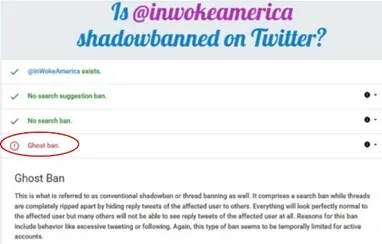
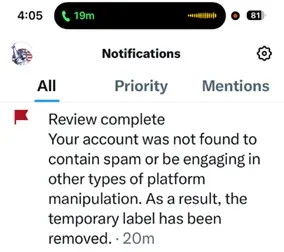
A wholly new and challenging gatekeeper promises to distribute news of the book across the Internet. Yet, we catch our web hosting provider red-handed, limiting access to the book’s website and outright denying it. Later, armed with our technical findings, we engage the host’s technical support agent in an eighty-minute version of ‘20 Questions’, eventually the agent exhausts the scope of her training in deflecting and delaying shadow-banned customers.
We clarify that our site is readily searchable by end users who rely on their standard browser, such as Chrome. We also confirm that access is denied to third parties that search without using a browser, such as ChatGPT, Perplexity, and many other inhabitants of the web. Having obtained such confirmation from the agent, we demonstrate that access to our site is restricted for such third parties, showing that their search attempts don’t return our site’s graphics, images, navigational menu, or other rich media, such as the audiobook sample and videos. Instead, those restricted searches find only a simple one-page site with text-only content. Even the book’s cover image is absent from their search results.
Once the agent can no longer fend off our questions, she relents, asking what we require to be satisfied. Suppressing our resentment, we identify six configuration settings she must change. Eleven minutes later, she returns, and access is much improved. The host provider’s transcript, with their logo and name, documenting the entire support call, is available at lifeinwokeamerica.com/bluehost-transcript. It’s worth reading, especially the lead-up to 12:50 am and 1:20 am, where the agent’s tactics are fully exposed.
Such gatekeepers are particularly challenging for most authors, who typically lack technical acumen. This is but one way Big Tech covertly bans perspectives it doesn’t want shared, placing a dark and heavy thumb on free speech and earning our mistrust.
We will soon join a world in which more than 50% of books are sold by a single provider, Amazon. Any issue that brings this book to the attention of the wrong people could realistically lead to more shadow-banning. And this time, it would be Amazon’s proprietary recommendation engine doing the work, which is a much more difficult challenge.
I might sound paranoid, peering suspiciously at every algorithm, but my concern seems justified, given the mysterious demotions in search results for conservative voices like Jordan Peterson5, coupled with China’s coercive ‘unrestricted warfare’ against America’s institutions.6
However, I’m also somewhat comforted by knowing that Amazon’s shadow-banning controversies are mild, its anti-fraud policies are strong, and no court rulings suggest that it operates outside anyone else’s consensus. Yet I’m on edge, knowing they’ve never sold a book like Life in Woke America at a time like this.
We must ask: Is this the future of free expression in publishing? Visit www.lifeinwokeamerica.com to read more, share your own gatekeeping stories, and join the fight against censorship of independent voices.
Endnotes:
- Color Revolution — a. YouTube video: youtu.be/gJnz9a9z5vM; b. “Chinese media call George Soros ‘global economic terrorist’,” Press TV: presstv.ir
- The Select Committee on the Chinese Communist Party, Investigation into the Reedley BioLab, United States Congress, September 2023 — a. Full report: lifeinwokeamerica.com/congressional-report; b. Official PDF: chinaselectcommittee.house.gov
- Little Ice Age in North America — a. NASA Earth Observatory (2023 update): roughly 1450 to 1850 AD, impacting local people; b. Britannica (updated 2024): approximately 1400–1850 AD, emphasizing glacial expansion with effects on agriculture and immigration patterns among indigenous peoples.
- Indigenous peoples settle along Texas rivers, followed by nomadic migrations: a first wave around 1300 AD using dog-pulled travois, likely Apachean, and a second wave on horseback (e.g. Comanche, Kiowa, and Apache adopting horses) post 1600 — a. americanindian.si.edu; b. thestoryoftexas.com
- Jordan Peterson, conservative voices suppressed — “Banning Jordan Peterson Book Inconsistent, But Not Anti-Freedom,” Liam Hehir, March 22, 2019.
- China’s ‘unrestricted warfare’ has coercive effect on American institutions — a. “Unrestricted Warfare – Warfare Beyond Rules,” Qiao Liang and Wang Xiangsui, two People’s Liberation Army colonels, 1999; b. 2024 U.S. House Oversight Committee characterizes China as conducting ‘unrestricted warfare’; c. RAND Corporation, mid-2020 report details nearly 80 gray zone tactics against U.S. allies.